New study reveals how plants worldwide respond to increasing water stress
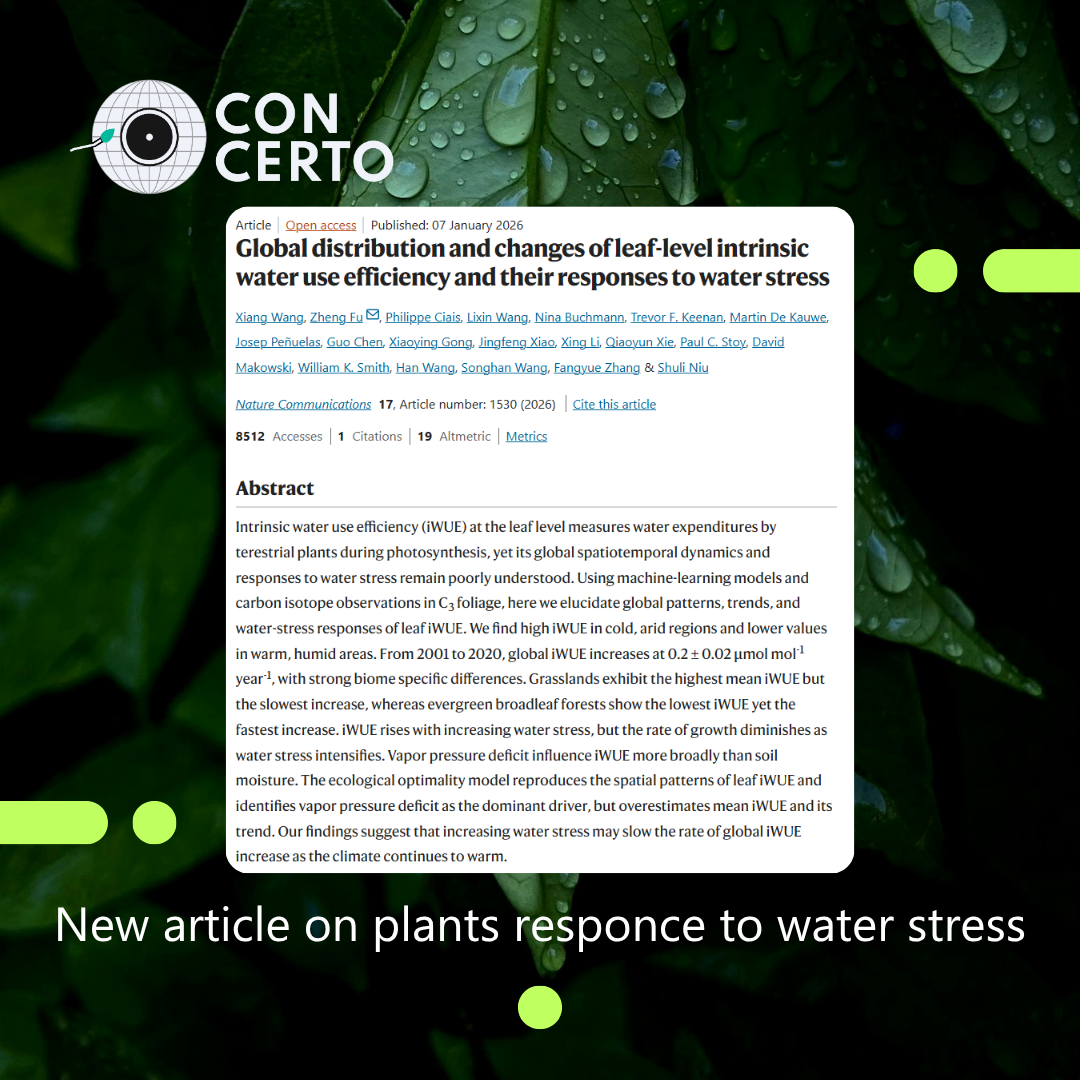
A new scientific publication developed through the work of CONCERTO partners from CREAF has been published in Nature Communications journal, providing important new insights into how terrestrial plants respond to water stress under changing climate conditions.
The study, titled “Global distribution and changes of leaf-level intrinsic water use efficiency and their responses to water stress”, explores the global patterns and long-term changes in intrinsic water use efficiency (iWUE) — a key indicator of how efficiently plants use water during photosynthesis. Understanding these dynamics is essential for improving climate predictions and assessing ecosystem resilience in a warming world.
Using machine-learning models combined with carbon isotope observations in C3 plant foliage, the researchers analysed global patterns of leaf-level iWUE between 2001 and 2020. The findings reveal that plants in colder and drier regions tend to use water more efficiently, while lower efficiency is observed in warm and humid environments.
The study also shows that global iWUE has steadily increased over the past two decades, although significant differences exist between ecosystems. Grasslands displayed the highest average iWUE values but experienced the slowest rate of increase, while evergreen broadleaf forests showed lower average efficiency yet the fastest growth over time.
Importantly, the research demonstrates that plant water-use efficiency increases under greater water stress, although this response weakens as stress intensifies. The analysis further identifies vapor pressure deficit, a measure linked to atmospheric dryness, as a more influential driver of iWUE changes than soil moisture.