New publication explores how soil microbes influence global carbon storage
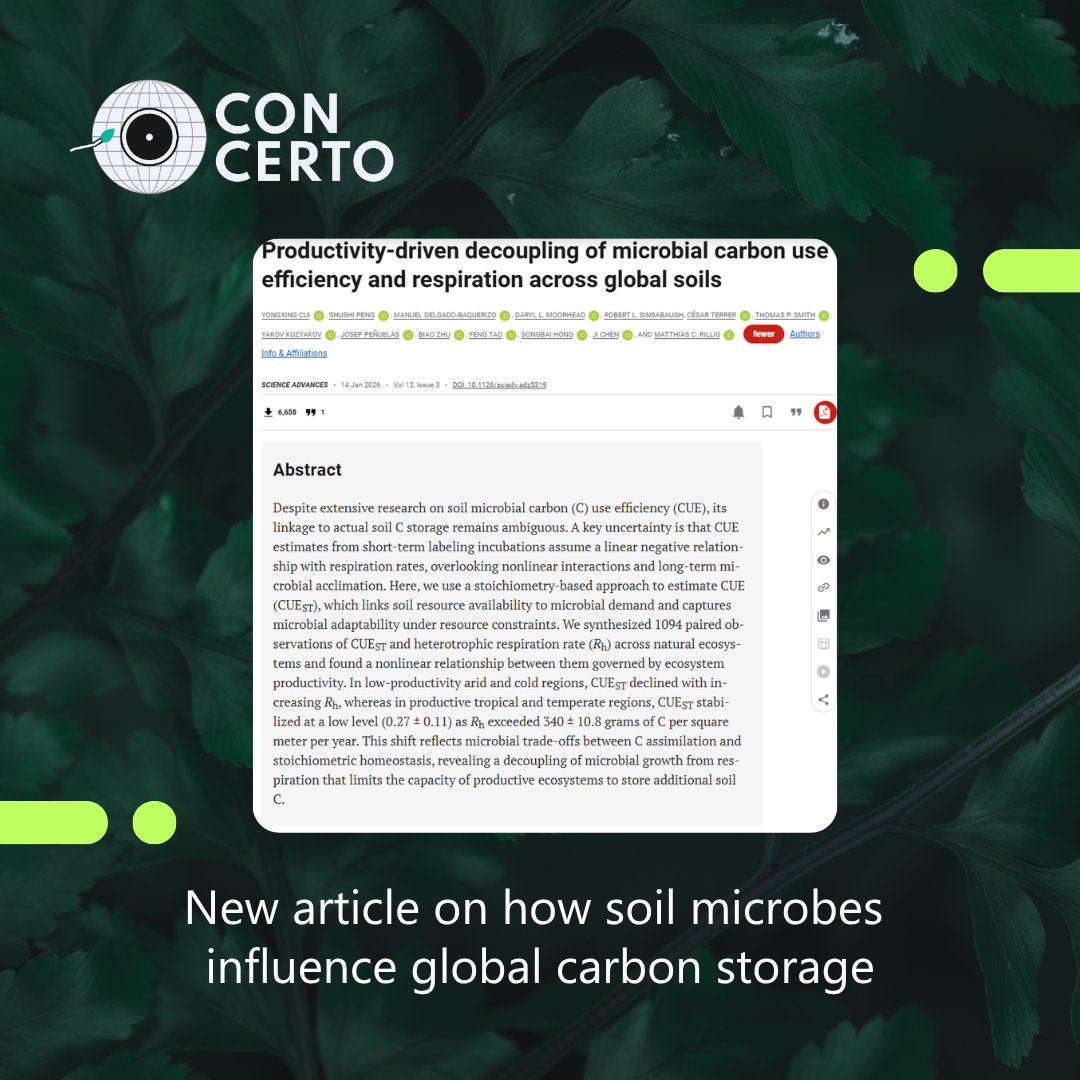
A new scientific publication developed through the work of CONCERTO partners from CREAF has been published in the Science Advances journal, offering new insights into how soil microorganisms regulate carbon storage across ecosystems worldwide.
The study, titled “Productivity-driven decoupling of microbial carbon use efficiency and respiration across global soils”, investigates the relationship between microbial carbon use efficiency (CUE) and soil respiration - two key processes that influence the global carbon cycle and climate regulation.
Soil microorganisms play a central role in determining whether carbon is stored in soils or released back into the atmosphere. However, understanding how efficiently microbes use carbon, and how this relates to long-term soil carbon storage, has remained a major scientific challenge.
To address this, the researchers applied a stoichiometry-based approach that considers how microbial communities adapt to resource availability and environmental constraints over time. By analysing 1,094 paired observations across natural ecosystems worldwide, the study identified a nonlinear relationship between microbial carbon use efficiency and soil respiration rates.
The findings reveal clear differences between ecosystems. In low-productivity environments such as arid and cold regions, microbial carbon use efficiency decreases as respiration increases. In contrast, highly productive tropical and temperate ecosystems show a stabilisation of microbial efficiency at relatively low levels, even when respiration rates continue to rise.
According to the study, this pattern reflects a trade-off between microbial growth and the maintenance of internal nutrient balance, leading to a decoupling between microbial growth and respiration processes. As a result, productive ecosystems may have a more limited capacity to store additional soil carbon than previously assumed.
These findings contribute to a deeper understanding of global soil carbon dynamics and provide valuable knowledge for improving climate and ecosystem models. The publication further highlights the important scientific contribution of CONCERTO partners from CREAF in advancing research on ecosystem functioning, biogeochemical cycles, and climate change interactions.