CONCERTO research explores how coastal dune vegetation responds to environmental disturbances
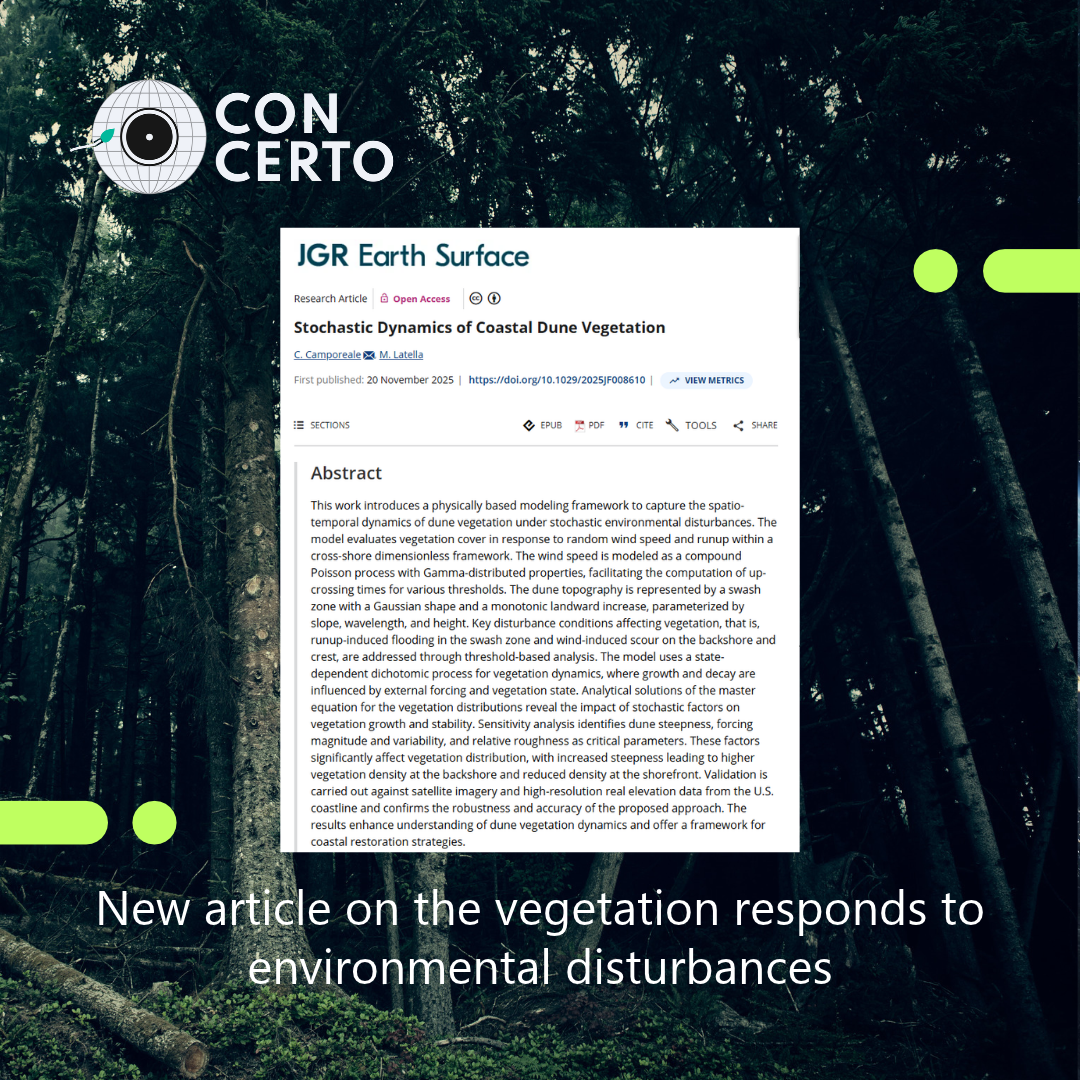
A new study by C. Camporeale and M. Latella from Politecnico di Torino, introduces a physically based modelling framework for understanding how vegetation on coastal dunes changes over time in response to natural environmental disturbances.
The research focuses on the effects of two key processes: flooding caused by wave runup in the swash zone and wind-driven sand scour affecting the backshore and dune crest. To represent the unpredictable nature of these disturbances, the model incorporates stochastic variations in wind speed and water runup and examines how vegetation growth and decline respond to different levels of environmental forcing.
The study combines a mathematical representation of dune topography with a state-dependent model of vegetation dynamics. By analysing the resulting vegetation distributions, the researchers identify several factors that strongly influence where vegetation develops and how stable it remains. These include dune steepness, the magnitude and variability of environmental forcing, and the relative roughness of the surface.
The results show that dune steepness can have contrasting effects across the coastal profile. Steeper dunes are associated with greater vegetation density towards the backshore, while vegetation density is reduced closer to the shorefront. The model also demonstrates how changes in the intensity and variability of wind and flooding disturbances can influence vegetation distribution and stability.
To assess the robustness of the approach, the researchers compared the model results with satellite imagery and high-resolution elevation data from the U.S. coastline. The validation supported the model's ability to reproduce observed patterns of dune vegetation.
By providing a framework for analysing vegetation dynamics under uncertain and changing environmental conditions, the study contributes to a better understanding of coastal dune ecosystems. Its findings may also support the development of more informed approaches to coastal restoration and management, particularly in environments where vegetation plays an important role in dune stability.